Vocation system: Difference between revisions
No edit summary |
No edit summary |
||
| Line 3: | Line 3: | ||
Only certain games within the series use a vocation system, with others having traits permanently fixed to characters. The system is always tied to the [[Alltrades Abbey]] present in the respective games, wherein characters can switch professions or combine past experiences to unlock advanced positions. | Only certain games within the series use a vocation system, with others having traits permanently fixed to characters. The system is always tied to the [[Alltrades Abbey]] present in the respective games, wherein characters can switch professions or combine past experiences to unlock advanced positions. | ||
==[[Dragon Quest III]]== | ==''[[Dragon Quest III]]''== | ||
Vocations make their proper series debut in the third title, wherein the concept of a vocation totally defines a character's abilities. Unless various stat-boosting seeds or [[Personality|personality]]-altering books are read in the remakes, any character in a given vocation is identical to the another of the same profession. | Vocations make their proper series debut in the third title, wherein the concept of a vocation totally defines a character's abilities. Unless various stat-boosting seeds or [[Personality|personality]]-altering books are read in the remakes, any character in a given vocation is identical to the another of the same profession. | ||
| Line 19: | Line 19: | ||
*[[Warrior]] | *[[Warrior]] | ||
==[[Dragon Quest VI]]== | ==''[[Dragon Quest VI]]''== | ||
In ''VI'', [[Alltrades Abbey (Dragon Quest VI)|Alltrades Abbey]] is unlocked by completing the first section of the game and defeating [[Murdaw]] in the [[Lower World]]. Because the game's cast is comprised of per-established characters with distinct personalities and stat growth tables, vocations affect a character's capabilities through ''percentages'' rather than hard numbers. For example, if [[Ashlynn]]'s wisdom is 100 when she has no vocation, having her undertake the path of a mage will grant a 20% boost to the stat and raise it to 120. Such changes are adjusted with natural increases awarded through leveling up, and will be removed if the vocation is switched. | In ''VI'', [[Alltrades Abbey (Dragon Quest VI)|Alltrades Abbey]] is unlocked by completing the first section of the game and defeating [[Murdaw]] in the [[Lower World]]. Because the game's cast is comprised of per-established characters with distinct personalities and stat growth tables, vocations affect a character's capabilities through ''percentages'' rather than hard numbers. For example, if [[Ashlynn]]'s wisdom is 100 when she has no vocation, having her undertake the path of a mage will grant a 20% boost to the stat and raise it to 120. Such changes are adjusted with natural increases awarded through leveling up, and will be removed if the vocation is switched. | ||
| Line 44: | Line 44: | ||
The Hero class is open to all characters and [[Monster recruitment|monster recruits]], but is most easily reached by the [[Hero (Dragon Quest VI)|main character]]. Finally, the game has two secret classes, the [[Dragon (Class)|Dragon]] and the [[Liquid Metal Slime (Class)|Liquid metal slime]]--monster based professions which can only be accessed through rare scrolls. | The Hero class is open to all characters and [[Monster recruitment|monster recruits]], but is most easily reached by the [[Hero (Dragon Quest VI)|main character]]. Finally, the game has two secret classes, the [[Dragon (Class)|Dragon]] and the [[Liquid Metal Slime (Class)|Liquid metal slime]]--monster based professions which can only be accessed through rare scrolls. | ||
==[[Dragon Quest VII]]== | ==''[[Dragon Quest VII]]''== | ||
The vocation implementation remains mostly unchanged from the previous game, though in the original PSX version there existed hybrid abilities that were unlocked through mastering certain positions sequentially. For example, a character could master [[Sword Dance]] by mastering the Warrior vocation right after the [[Dancer]]. This aspect was removed in the 3DS remake, with the hidden abilities being incorporated into the normal repertoire. | The vocation implementation remains mostly unchanged from the previous game, though in the original PSX version there existed hybrid abilities that were unlocked through mastering certain positions sequentially. For example, a character could master [[Sword Dance]] by mastering the Warrior vocation right after the [[Dancer]]. This aspect was removed in the 3DS remake, with the hidden abilities being incorporated into the normal repertoire. | ||
| Line 114: | Line 114: | ||
*[[Slaughtomaton (Vocation)|Slaughtomaton]] | *[[Slaughtomaton (Vocation)|Slaughtomaton]] | ||
==[[Dragon Quest IX]]== | ==''[[Dragon Quest IX]]''== | ||
''IX'' has a system which is similar to the one in ''III'', in which a vocation defines a character and where the player may create party members and add them to the party. This can be done at the [[Quester's Rest]] located in [[Stornway]], by speaking to [[Patty]]. Party members created do not play any significant part in the plot. | ''IX'' has a system which is similar to the one in ''III'', in which a vocation defines a character and where the player may create party members and add them to the party. This can be done at the [[Quester's Rest]] located in [[Stornway]], by speaking to [[Patty]]. Party members created do not play any significant part in the plot. | ||
| Line 145: | Line 145: | ||
</gallery> | </gallery> | ||
{{ | {{Series_mechanics}} | ||
[[Category:Classes|*]] | [[Category:Classes|*]] | ||
Revision as of 11:01, 8 May 2018

The Vocation is a role that describes the attributes and characteristics of a character throughout the game. The System is the set of rules and requirements for changing a given character's vocation in Dragon Quest games. Only certain games within the series use a vocation system, with others having traits permanently fixed to characters. The system is always tied to the Alltrades Abbey present in the respective games, wherein characters can switch professions or combine past experiences to unlock advanced positions.
Dragon Quest III
Vocations make their proper series debut in the third title, wherein the concept of a vocation totally defines a character's abilities. Unless various stat-boosting seeds or personality-altering books are read in the remakes, any character in a given vocation is identical to the another of the same profession.
In III, the player begins with only the Hero and can enlist up to three additional party members from Patty's Party Planning Place. These characters represent different vocations and it is up to the player to decide what party members they want for their team, and at any time the player can leave and replace party members there. Each of the jobs has its own strengths and weaknesses which allows the player to build a team based on their own preferences. The party members who are kept in the tavern will depart the team with whatever stats and equipment that they gained during their travels.
About one-third of the way through the game, the player will reach Alltrades Abbey which will allow the player to change a character's vocation. Changing vocations drops a character to level 1 with half of their previous stats (and all learned spells if any), allowing particularly patient players potential to develop a perfect character without resorting to seed searching. The Sage is a hidden vocation unlocked by bringing the Words of Wisdom to the abbot or through getting a Gadabout to level 20. The Hero cannot change class at any time.
Available vocations are:
Dragon Quest VI
In VI, Alltrades Abbey is unlocked by completing the first section of the game and defeating Murdaw in the Lower World. Because the game's cast is comprised of per-established characters with distinct personalities and stat growth tables, vocations affect a character's capabilities through percentages rather than hard numbers. For example, if Ashlynn's wisdom is 100 when she has no vocation, having her undertake the path of a mage will grant a 20% boost to the stat and raise it to 120. Such changes are adjusted with natural increases awarded through leveling up, and will be removed if the vocation is switched.
Unlike in III, this game starts with nine available classes. Each of the classes has eight ranks that can be reached by battling the required number of monsters, unlocking new abilities at each interval. Through mastering the initial jobs, advanced classes can be unlocked for that character which combine aspects of the prerequisites. For example, mastering the Warrior and the Martial Artist classes will allow the character to become a Gladiator. Skills and spells mastered in one profession are permanently learned by a character. Available vocations are:
Advanced vocations include:
The Hero class is open to all characters and monster recruits, but is most easily reached by the main character. Finally, the game has two secret classes, the Dragon and the Liquid metal slime--monster based professions which can only be accessed through rare scrolls.
Dragon Quest VII
The vocation implementation remains mostly unchanged from the previous game, though in the original PSX version there existed hybrid abilities that were unlocked through mastering certain positions sequentially. For example, a character could master Sword Dance by mastering the Warrior vocation right after the Dancer. This aspect was removed in the 3DS remake, with the hidden abilities being incorporated into the normal repertoire.
Additionally, party members can also become monsters by using Monster Hearts. By putting a monster heart in their inventory and speaking to the abbot or High Priestess Jacqueline, they can become that monster. In the PSX version the character would not take on the appearance of the monster until mastering the vocation, where as they immediately become beastly in the remake. Furthermore, monster classes are the only way to permanently learn advanced skills and spells in the remake. In all, there are over fifty classes that a single character can become in VII. Beginner Human Vocations:
Intermediate Human vocations:
Advanced Human vocations:
Initial Monster vocations:
- Berserker
- Chimaera
- Goodybag
- Healslime
- Jawtoise
- Kingfuchsia
- Lips
- Mandrake major
- Mimic
- Notso macho
- Rockbomb
- Serial quiller
- Slime
- Walking corpse
Intermediate Monster vocatios:
- Automaton
- Barbatos
- Bone baron
- Delusionist
- Dingbat
- Draguar
- Drake slime
- Golem
- Malevolantern
- Rashaverak
- Seasaur
- Well wisher
Advanced Monster vocations:
- Black bishop
- Djinn genie
- Ersatz Estark
- Galumph
- Gripevine
- Platinum king jewel
- Prism peacock
- Slaughtomaton
Dragon Quest IX
IX has a system which is similar to the one in III, in which a vocation defines a character and where the player may create party members and add them to the party. This can be done at the Quester's Rest located in Stornway, by speaking to Patty. Party members created do not play any significant part in the plot.
Vocations can be changed at the Alltrades Abbey, after the player has rescued Abbot Jack. There is no minimum level limit for changing classes, dubbed Re-vocating. One notable difference from past games is that spells are no longer carried over between class changes. A character must be a specific class to use that classes spells. Skills do carry over, and there are also methods for utilizing each weapon type with all classes.
Additional vocations must be unlocked by doing quests before the player can switch to them. Notably, the Sage class is accessible only later in the game, but includes a specific ability, Jack's Knack, which allows the party members to change class at any time and place.
There are a total of 12 classes available in IX:
- Armamentalist
- Gladiator
- Luminary
- Martial Artist
- Mage
- Minstrel
- Paladin
- Priest
- Ranger
- Sage
- Thief
- Warrior
Related articles
Gallery
-
 Manga explaining the ups and downs of vocations in the Victory Jump gudiebook to VI
 -
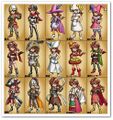 Maribel presenting all human vocations available in VII
 -
 Vocations present in Caravan heart


