The Beakon is a monster in the series.
Beakons are large, flightless birds whose bodies are simply made up of a large head and a long pair of legs. They have the heads of birds of prey, with mostly brown feathers and black around their eyes and large, sharp beaks. The beakons often have the ability to attack twice per turn, in some games having the ability to perform loud squawks that intimidate their opponents or can call for more of their kind.
Beakon (おおくちばし Ōkuchibashi)
Bestiary Number: #057
|
|
|
| Resistances
|
|
|
| Additional information
|
|
|
Beakon (おおくちばし, Ōkuchibashi )
Defeated Monster List number: #063
|
| Attributes
|
|
|
| Resistances
|
|
|
|
|
| Additional information
|
|
|
| Description
|
These brutal birds are consumed by rage upon seeing an enemy, instantly heading off to munch on them with their beefy bills.
|
|
Beakon (おおくちばし, Ōkuchibashi)
Defeated Monster List No. : #070
|
|
|
|
|
| Additional information
|
| Spells
|
Skills
|
Locations
|
Dropped items
|
| None
|
Acts twice per turn
Calls for backup (Beakon)
War Cry
Flee
|
Lonely Plains
|
Chimaera wing1⁄16
Clogs1⁄32
|
| Description
|
Barbaric birds that attack twice with deadly drumsticks and cry cacophonously to creep out foes and call forth friends.
They evolved from big birds who swooped down from the skies to settle on the land, and had no further need of their wings.
|
|
Beakon appeared from the beginning of the game. When they become enraged, they are able to perform a Jump Strike and will flee when threatened. Starting with Version 5.0, vicious beakons can be encountered in the Netherworld, as well. They can still perform a jumping attack and no longer flee.
Beakon appeared in the standard card pack as a normal rarity card common to all leader characters.
- All three beakons bear a resemblance to the Phorusrhacidae family of flightless birds. More commonly known as terror birds, these walking hatchets possessed enormous beaks and existed as apex predators in the plains of South America roughly 2 million years ago in the Cenozoic era.
- The beakon's English name is a play on "beak" and "beacon". Its Japanese name, ōkuchibashi, literally means "large beak" or "giant beak".
| Language |
Translation |
Meaning |
 Español Español | Aticuécano | Possibly derived from the Spanish atizar, alicuécano, a term for an annoying or bothersome person, or alicucu. |
 Français Français | Rapastrident | From the French rapace and strident. |
 Deutsch Deutsch | Schandschnabel | From the German Schande and beak, bill. |
 Italiano Italiano | Semplibeck | From the Italian semplice and the German Beck, the beak of a bird of prey. |







 Español
 Français
 Deutsch
 Italiano
 A beakon in X
 A vicious beakon in X
 A Beakon in the 1991 anime of The Adventure of Dai.
 Stars model
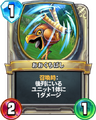 Rivals card
 Walk model


